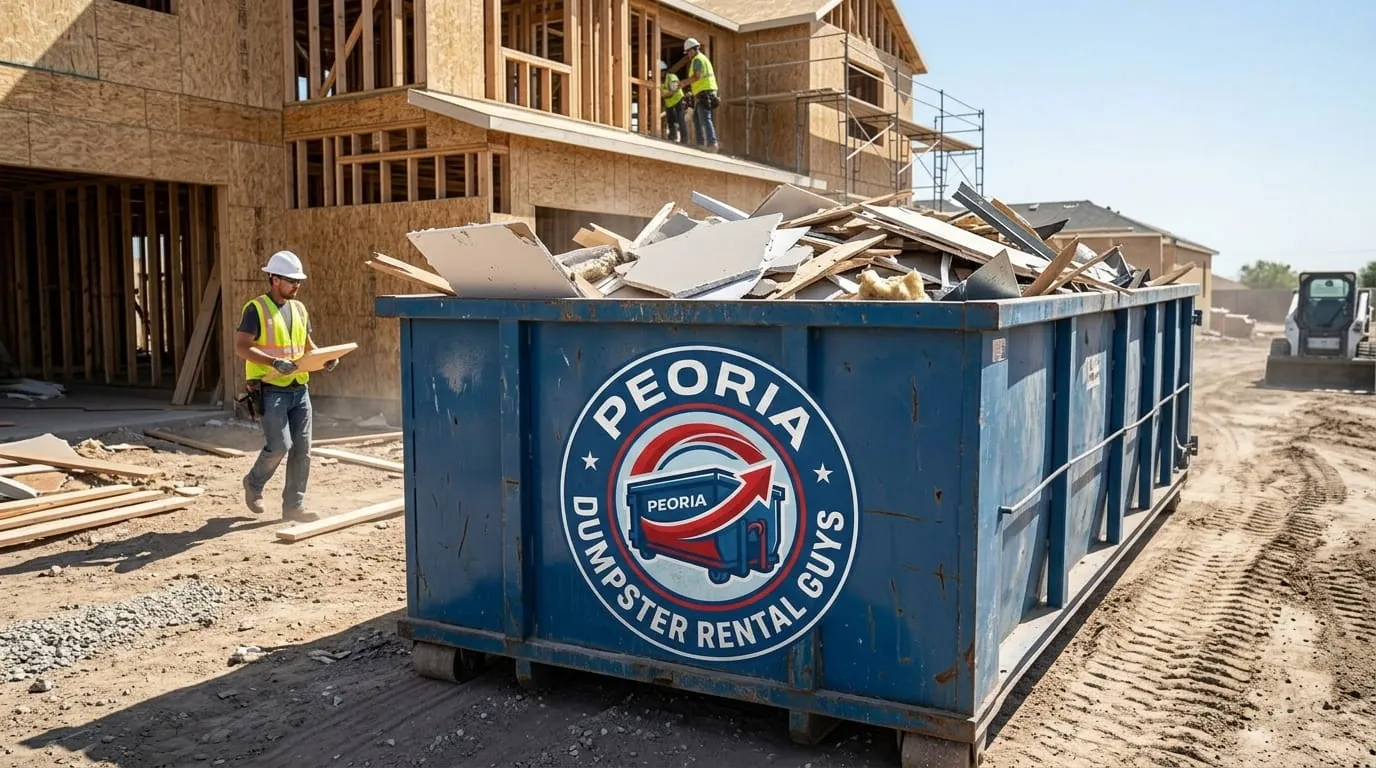
It is one of the first questions we get when a homeowner or contractor calls us about a roll-off in Peoria: "Do I need a permit to put a dumpster here?" The honest answer is the one nobody loves to hear at first: it depends. But it depends on a small, predictable set of factors, and once you understand them, the whole thing stops feeling complicated. In most cases across Peoria, the answer is no permit at all. In a smaller number of cases, you will need a permit from the City of Peoria. And in a surprising number of West Valley neighborhoods, the real gatekeeper is not the city at all, it is your homeowners association.
This guide walks through all three scenarios in plain language so you know what to expect before your container ever shows up. As a local company that drops dumpsters across Peoria every week, from Old Town out to Vistancia, we have coordinated placement in just about every situation you can imagine, and we are happy to handle the legwork for you.
The Short Answer
Here is the rule of thumb we give every customer:
- Dumpster on your own private driveway or property: Usually no city permit is required.
- Dumpster on a public street, alley, or the right-of-way: You will typically need a permit from the City of Peoria.
- Dumpster inside a master-planned or HOA community: The city rules still apply, but your HOA may add its own requirements, and those are often stricter than anything the city asks for.
That is the whole thing in three lines. The rest of this article explains the why behind each one, who is responsible for pulling paperwork, how long it tends to take, and how our crew usually keeps the entire process on your own property so you can skip permits altogether.
Private Driveway or Property: Usually No Permit
The vast majority of the residential dumpsters we deliver in Peoria sit on a private driveway, and that scenario almost never requires a city permit. When the container stays entirely on land you own or control, the City of Peoria generally is not involved in approving placement. You are using your own property, you are not blocking a public travel lane, and you are not encroaching on city-maintained pavement or sidewalk.
This is exactly why we recommend a driveway drop whenever it is practical. It is faster to schedule, it avoids permit fees and processing time, and it keeps the whole job under your control. A standard 10, 15, 20, or 30 yard roll-off fits comfortably on most Peoria driveways, and our drivers are experienced at angling the container so it does not overhang into the street or the sidewalk.
A few things to keep in mind even on private property. First, protect your surface. Concrete and pavers can be scratched or cracked by the container's rails or by the truck's rollers, so we take steps to cushion the contact points. We cover this in more detail in our guide on how to protect your driveway during a dumpster rental. Second, make sure the container does not block a shared access easement or a neighbor's driveway. Third, if you are in an HOA community, read the section below before you assume you are in the clear, because private property does not automatically mean HOA-approved.
Public Streets and Right-of-Way: When You Likely Need a Permit
Sometimes a driveway simply will not work. Maybe your driveway is short or steep, maybe it is already full of vehicles, maybe the job is a curbside project, or maybe access is tight. In those cases the container has to go on the street, and that changes the picture.
The public street, the curb lane, and the strip of land between the sidewalk and the road are part of what is called the public right-of-way. When you place anything in that space, including a dumpster, you are placing an object in an area the City of Peoria manages for public travel and safety. To do that legally, the city generally requires a right-of-way or encroachment permit.
What a Right-of-Way or Encroachment Permit Covers
The purpose of this permit is not to make your life difficult. It exists so the city knows an object is temporarily occupying the right-of-way, so that the placement does not create a hazard for drivers, cyclists, or pedestrians, and so that emergency access and traffic flow are preserved. A permit typically comes with conditions about where the container can sit, how it must be marked, how long it can stay, and how it should be made visible at night. Following those conditions is what keeps the permit valid.
Who Pulls the Permit
Responsibility for the permit usually falls to the property owner or the contractor doing the work, since they are the party occupying the right-of-way. That said, we do not leave our customers to figure it out alone. Our team can help you understand what the City of Peoria will want, point you to the correct department, and coordinate the timing so your permit lines up with your delivery. When a street placement is unavoidable, we walk you through it step by step. The simplest way to start is to reach out to our team and tell us the address and the job, and we will help map out the path.
Timeline Expectations
This is the part where we have to be careful and honest: exact processing times, fees, and requirements change, and they are set by the City of Peoria, not by us. We are not going to quote you a specific dollar figure or a guaranteed turnaround, because those details can shift and we do not want to give you a number that turns out to be wrong. As a general planning guideline, treat a right-of-way permit as something that may take several business days to process rather than something you can arrange the morning of your delivery. Build in a buffer, apply early, and confirm the current requirements directly with the City of Peoria. If you want, we will help you make that call and time everything so your dumpster arrives after the permit is in hand.
HOA Rules: Often the Bigger Hurdle in the West Valley
Here is the part that catches many Peoria residents off guard. If you live in one of the area's master-planned communities, your homeowners association may have rules about dumpsters that are stricter and more specific than anything the city requires. In our experience, the HOA is frequently the bigger hurdle, not the city permit.
Peoria and the surrounding West Valley are full of these communities. Vistancia, Trilogy, Fletcher Heights, and many others operate under recorded covenants and architectural or community guidelines. Those documents often address exactly how long a container can sit in a driveway, whether it can be visible from the street, whether you need advance notice or written approval, and where on the lot it may be placed.
What HOA Rules Commonly Address
Every association is different, so treat the list below as the kinds of things to look for rather than a promise of any specific community's rules:
| Common HOA Concern | What It Usually Means for Your Rental |
|---|---|
| Duration limits | A cap on how many days a dumpster can remain on the property, sometimes just a week or two. |
| Advance approval | A requirement to notify or get written sign-off from the HOA or management company before delivery. |
| Visibility and screening | Rules about the container being seen from the street or from neighbors, occasionally requiring placement out of sight. |
| Placement location | Restrictions keeping the container on the driveway only, never on common areas, landscaping, or the street. |
| Street parking bans | Many communities prohibit long-term objects in the street entirely, which removes the street option before the city permit even comes up. |
The takeaway is simple. Before you schedule a dumpster in an HOA neighborhood, check your community's rules and, if there is any doubt, contact your management company. A quick email up front is far easier than moving a full container later because it violated a covenant. We coordinate with residents in these communities constantly, so if you tell us where you are, we can often flag the likely constraints before we ever roll out.
Placement, Marking, and Safety
Whether your dumpster is on a driveway or, with a permit, on the street, safe placement matters. On a driveway, we position the container so it does not block sightlines at the end of the drive and does not overhang the sidewalk or curb. On a street, permit conditions usually call for the container to be visible, which can mean reflective markings or warning devices so that drivers can see it after dark. The goal is always the same: keep the container from becoming a hazard to anyone using the road or walkway.
Loading matters too. Keep debris level with the top rails rather than mounded over, because an overfilled container cannot be legally or safely hauled, and material sticking out past the sides is a road hazard. If you are unsure how much you can fit, our roll-off options and sizing help are laid out on our roll-off dumpster rental page.
How Our Team Helps You Avoid a Street Permit
Most of the time, the cleanest solution is to never touch the right-of-way at all. Here is how we usually keep placement on private property and skip the permit process entirely:
- We assess your driveway first. Before delivery, we talk through the space, the slope, and access so we can confirm the container will fit fully on your property.
- We right-size the container. Choosing an appropriate size means it fits the space without hanging into the street. A container that is too large for a tight driveway is what pushes people toward street placement.
- We angle and position carefully. Our drivers are practiced at setting a container so it clears the sidewalk and the curb while still leaving you room to work.
- We coordinate with your HOA constraints. If your community limits duration or visibility, we plan the drop and pickup windows around those rules.
- We handle the paperwork when a street drop truly is the only option. If the driveway genuinely will not work, we help you pursue the City of Peoria permit rather than leaving you to sort it out alone.
This approach is why so many of our residential jobs never need a city permit at all. You can see the range of household and cleanout options on our residential dumpster rental page, and if you want to understand what a rental will run before you book, our breakdown of dumpster rental cost in Peoria, AZ lays out the pieces that shape the price.
A Quick Checklist Before Your Dumpster Arrives
- Decide whether the container will sit on your driveway or the street. Driveway is simpler and usually permit-free.
- If the street is unavoidable, plan to arrange a City of Peoria right-of-way permit and build in lead time.
- If you are in an HOA community like Vistancia, Trilogy, or Fletcher Heights, check the covenants and contact your management company before you book.
- Protect your driveway surface and keep the container clear of sidewalks, easements, and neighbors' access.
- Confirm current city and HOA specifics directly, since details change, and let us help you coordinate the timing.
Permits sound intimidating, but for most Peoria homeowners the reality is refreshingly simple: a driveway drop, no city paperwork, and a quick check of your HOA rules. When the situation is more involved, that is exactly what we are here for. Tell us your address and your project, and we will help you land on the easiest legal placement, coordinate any permit that is genuinely required, and get your container where it needs to be.
Ready to book or just have a question about placement at your address? Call us at (928) 543-0503 or get in touch with our Peoria team and we will take it from there.
Founder, Peoria Dumpster Rental Guys — sharing straight advice from more than 15 years of local hauling experience.
Frequently Asked Questions
Do I need a permit to put a dumpster on my driveway in Peoria?
In most cases, no. When the container sits entirely on your own private driveway or property and does not overhang the sidewalk or street, the City of Peoria generally does not require a permit. This is why we recommend a driveway drop whenever it is practical. If you live in an HOA community, still check your community rules, since those can apply even on private property.
When do I need a City of Peoria permit for a dumpster?
You typically need a right-of-way or encroachment permit when the dumpster will sit on a public street, alley, curb lane, or the right-of-way rather than on private property. That permit lets the city ensure the placement is safe and does not block travel or emergency access. Requirements and fees are set by the City of Peoria and can change, so confirm the current details with them, and we are glad to help you coordinate.
Who is responsible for pulling the dumpster permit?
Responsibility usually falls to the property owner or the contractor occupying the right-of-way. You do not have to handle it alone, though. Our team can point you to the correct City of Peoria department, explain what they will want, and time your permit with your delivery so everything lines up. When a street placement is truly the only option, we walk you through the process step by step.
How long does it take to get a right-of-way permit in Peoria?
Exact processing times change and are set by the City of Peoria, so we cannot promise a specific turnaround. As a planning guideline, treat it as something that may take several business days rather than same-day, and apply early with a buffer built in. Confirm current timelines directly with the city, and we can help you make that call and schedule your dumpster to arrive after the permit is approved.
Do HOA rules affect dumpster placement in West Valley communities?
Yes, and often more than the city does. Master-planned communities like Vistancia, Trilogy, and Fletcher Heights frequently have covenants covering how long a dumpster can stay, whether it can be visible from the street, and whether you need advance approval. These rules can be stricter than any city requirement, so check your covenants and contact your management company before booking. We coordinate around these constraints all the time.